Technology
For the past two years, the gaming industry has been navigating one of its most difficult periods in
recent memory.
Layoffs, studio closures, project cancellations, restructuring, and tighter investment decisions
became common headlines. Even companies with strong games and established franchises were not
immune to the pressure.
But something appears to be changing.
As we move through 2026, there are increasingly visible signs of stabilization across parts of the
global games industry. Hiring is returning in selected areas, professionals are announcing new roles
and promotions, studios are rebuilding teams, and industry events are showing renewed confidence
and activity.
So, are the difficult days behind us?
The most important thing to understand about the current market is that this is not a return to the
hiring environment of 2020 or 2021.
The industry has learned some expensive lessons.
During the pandemic years, gaming experienced extraordinary growth in engagement, investment,
and expectations. Companies expanded teams, increased production ambitions and invested heavily
in new projects.
When consumer behaviour normalized, the industry faced a difficult adjustment.
The result was not necessarily a collapse in demand for games. Instead, it was a correction in how
games were funded, developed, and staffed.
Today, the conversation is increasingly shifting from:
to:
That is a significant change.
The global games market has continued to demonstrate resilience, with recent market estimates
pointing toward renewed revenue growth across major gaming platforms.
At the same time, employment has not recovered at the same pace.
This creates an unusual situation.
We can have a growing games market while companies continue to reduce costs, restructure teams,
and selectively hire.
That is not necessarily contradictory.
It reflects a broader transformation in the economics of game development.
Companies are becoming more selective about which projects they fund, how large internal teams
need to be, where talent is located, and which capabilities should be built internally versus accessed
through external partners.
One of the clearest indicators of industry sentiment this year has been the level of activity
surrounding Gamescom.
The scale of participation, international presence, new game announcements, business meetings,
and developer activity provided a very different atmosphere from the defensive mindset that
dominated much of the industry during the peak of the downturn.
Events like Gamescom do not eliminate the challenges facing the industry.
But they do provide an important signal.
The industry is still investing.
Studios are still developing.
Publishers are still looking for opportunities.
Developers are still building new relationships.
And businesses across the ecosystem are preparing for what comes next.
That matters.
It would be premature to declare the end of gaming layoffs.
Major companies continue to restructure, and some studios are still closing or reducing their workforce.
The difference is that layoffs are increasingly happening alongside hiring.
That is an important distinction.
Instead of a market where almost every company is focused primarily on reducing headcount, we are
beginning to see a more mixed environment:
Some companies are still cutting.
Some are rebuilding.
Some are hiring selectively.
Some are investing in new projects.
Some are changing the way they use talent altogether.
This is what an industry transition looks like.
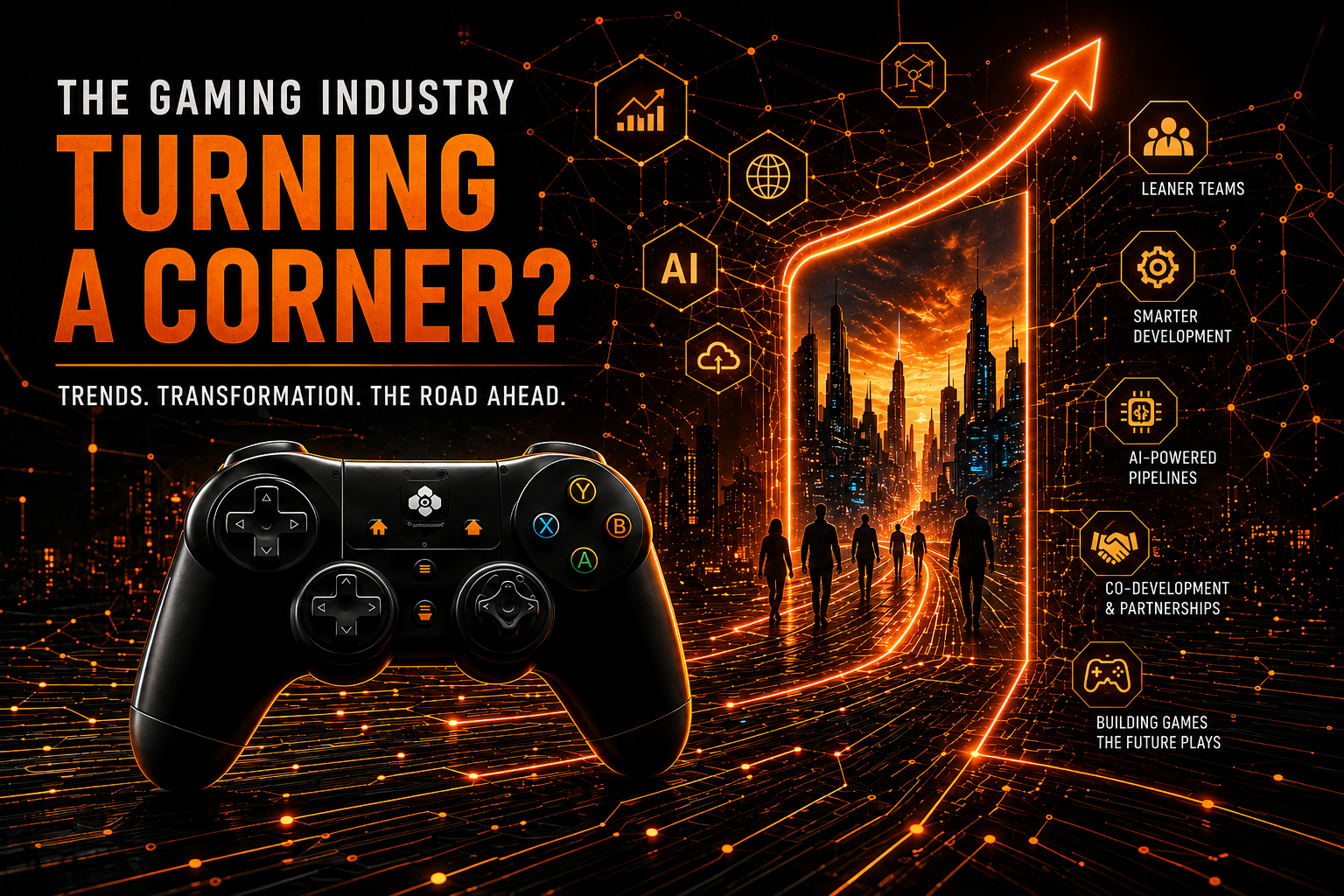
If the gaming industry enters a stronger growth cycle over the next few years, I don't believe it will
simply recreate the model we saw before the correction.
The next phase is likely to be more disciplined.
Studios will continue looking for ways to control production costs without compromising quality.
Publishers will continue evaluating projects more carefully.
Teams may remain leaner.
Technology and AI will increasingly become part of production workflows.
External development and co-development will become more strategically important.
And global talent will continue to play a larger role in how games are produced.
In other words, growth does not necessarily mean every studio needs to dramatically increase its
permanent headcount.
Growth can also mean building a more flexible production ecosystem.
One of the biggest changes we are seeing across the industry is the growing importance of
specialized external partners.
A studio may not want to permanently add dozens of employees for every stage of a project.
Instead, it may need additional capacity at specific moments:
During production peaks.
Before a major milestone.
During certification.
For localization.
For QA.
For ports.
For live operations.
For art production.
For engineering support.
Or when a project requires a specialized capability that is not available internally.
This model gives studios greater flexibility while allowing them to maintain control over their core
teams and creative direction.
For service providers, however, this also raises the bar.
The industry no longer needs vendors that simply provide additional people.
It increasingly needs partners who can understand production challenges, integrate into existing
workflows, use technology effectively, and deliver measurable value.
Another major factor is the rapid adoption of AI across development workflows.
AI is unlikely to be a simple replacement for game developers.
The more interesting question is how it changes productivity.
Can teams iterate faster?
Can repetitive tasks be reduced?
Can QA coverage increase?
Can developers identify problems earlier?
Can production teams make better decisions using data?
Can smaller teams achieve the output that previously required much larger organizations?
These questions are already influencing how companies think about their production pipelines.
The winners will not necessarily be the companies that use the most AI.
They will be the companies that use technology intelligently while maintaining the creativity, quality,
and human judgment that make games successful.
There is reason for optimism, but also a reason to remain realistic.
The recovery is unlikely to benefit every role and every region equally.
Highly specialized talent, experienced developers, technical expertise, and people who can work
across disciplines may continue to be in strong demand.
At the same time, entry-level opportunities remain a little challenging in many parts of the industry.
For professionals, the message may therefore be less about waiting for the old market to return and
more about adapting to the new one.
But so do adaptability, cross-functional experience, production awareness, communication, and the
ability to work effectively with modern development tools.
I would say something slightly different.
The difficult correction of the past few years has forced companies to rethink how games are
financed, developed, staffed, and supported.
Some of those changes have been painful.
But they may also create a healthier foundation for the next phase of the industry.
The signs in 2026 are encouraging:
More activity.
More projects.
Selective hiring.
Renewed investment.
Stronger industry events.
Growing demand for specialized capabilities.
And increasing interest in more flexible production models.
There will undoubtedly be more restructuring ahead. The industry is too large and too diverse for
every company to recover at the same speed.
But the conversation is changing.
And perhaps that is the most important signal of all.
We are moving from a period defined primarily by contraction toward one defined by selective
growth, efficiency, and reinvention.
For everyone working in games, building games, investing in games, or supporting the ecosystem,
that is a reason to be cautiously optimistic about what comes next.
And that could be a good thing.
At NovaPatterns, we believe the next generation of game development will be built around a
combination of AI integration, great people, specialized expertise, intelligent technology, and
flexible production models. The opportunity ahead is not simply to build more, but to build
better and more efficiently.